It was the heart and mind of Badiuzzaman Said Nursi that produced the Risalei Nur which means “The Epistle of Light,” an exposition upon the Holy Quran of Prophet Muhammad (ﷺ) for its treasures of meaning and truth.
He is a hidden jewel, a reviver and protector of the religion on par with predecessors such as Ghazali the author of Ihya al Ulum, Ibn Arabi the author of Futuhat al Makkiyya, and Ahmad Sirhindi the author of the Maktubat.
The Risalei Nur is not like a traditional work of Quranic exegesis which would comment on verses in chronology. Nursi prefers to teach the broad themes found in the Quran through parables, stories and examples.
He was born in the city of Nurs in eastern Turkey to devout Muslim parents in 1877. He descended from the Prophet's family, from Hasan through his father and from Husayn through his mother. Those that interacted with him perceived his great acumen and potential and one of his teachers cherished him with the epithet of Badiuzzaman which means “Wonder of the Age.”
He began his studies at the age of nine and progressed at such a speed that by 13 or 14, he completed the entire Ottoman seminary curriculum which would ordinarily take over a decade. It seems that he internalized all that he learned. He had a photographic memory, and it is recorded that he memorized roughly 90 volumes of religious works and would recall from any passage as required.
I was taken aback by the particular historical context of Nursi's life, his experiences and brave personality. Nursi saw the last few decades of the Ottoman Empire, its official end in 1922 after World War I, and the final abolishment of the Caliphate in 1924 when Abdul Mejid II was exiled.
The year 1924 marked a turning point when the Islamic Caliphate which had united the Ummah (Muslim community) was terminated for the first time after its inception more than a millennia earlier at the death of the Prophet.
The Ottoman heritage of 600 years which had promulgated the Islamic ethos was followed by a period never seen before, characterized by irreligion. Mustafa Kemal Ataturk rose to power and established the Republic of Turkey which the Republican People's Party ruled for 25 years.
New policies were instituted such as the ban on using Arabic in the prayers and wearing the Hijab, alcohol and pork were endorsed and businesses such as bars and casinos were opened. It was followed by the Democrat Party for 10 years which facilitated a return to Islamic ideals.
Thus, Nursi splits his life (83 years from 1877-1960) into three periods:
- Old Nursi
This period extends from his birth to the early 1920s. He was involved in political affairs and was occupied with intellectual and rational study to counter materialism and atheism, and proposed education reform to synthesize religious and natural sciences. In 1911, he gave a sermon at the Umayyad Mosque in Damascus, Syria which was attended by thousands of people in which he addressed the way forward for the Muslim world. He was certain that the Quran would prevail in the future.
His message is recorded in The Damascus Sermon. He began establishing Madrasat al Zahra in Van in order to synthesize the religious and modern sciences, but World War I broke out from 1914-1918 and his vision was left incomplete.
Nursi defended the eastern border as a commander against the Russian attack on Turkey. In 1915, he wrote a masterful work, Isharat al I’jaz (Signs of Miraculousness) in the trenches of the battlefield. He was imprisoned in Kostroma, Russia for two years as a captive and many of his students were executed.
He escaped to Istanbul, and was made a member of Dar ul Hikmet ul Islamiye. He visited Ankara in 1922 and published multiple works, then returned to Van a year later.
- New Nursi
This period extends from the mid 1920s to roughly 1950. It is characterized by an indrawn Nursi who abstained from political engagement and produced the Risalei Nur throughout the uncertain decades.
Nursi lived a life of displacement in foreign lands between imprisonment and exile, in which his heart and mind seem thoroughly placed in the remembrance of God. He was imprisoned or exiled over eleven times. If exiled or jailed alone, he would be preoccupied with worship, deep reflection and thought. If accompanied by his disciples, they would transcribe his teachings then share handwritten copies to be spread across Turkey in secret.
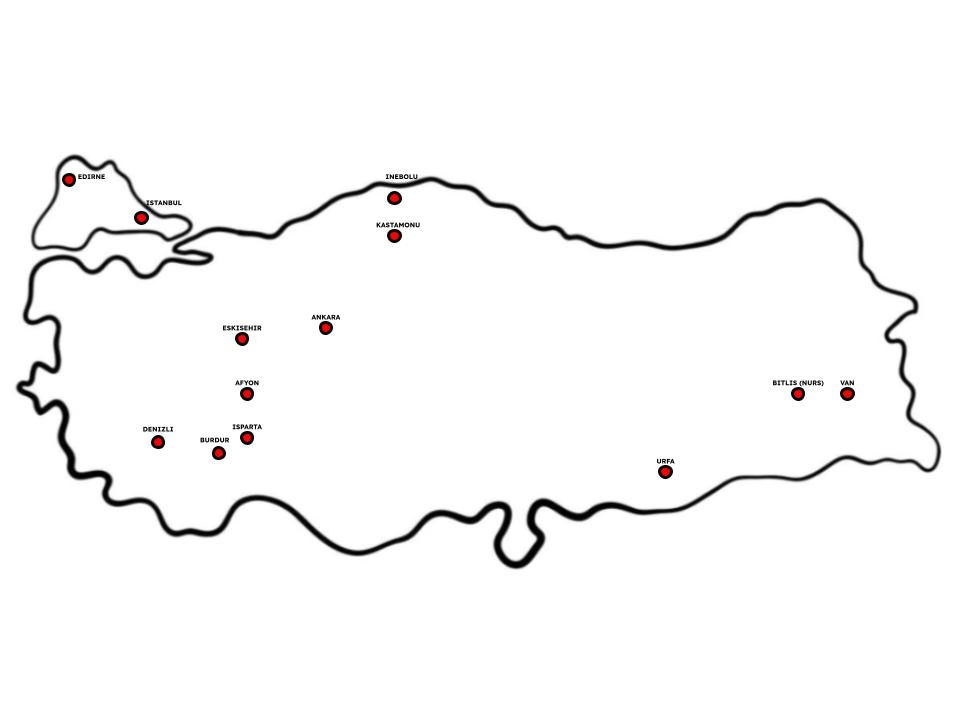
He was exiled in 1925 to the western provinces of Anatolia for 25 years until around 1950 when he wrote most (3/4th) of the Risalei Nur. He was between cities such as Burdur, Isparta, and especially the village of Barla where he was for 8 years and composed the Barla Addendum.
In 1935 he was put in Eskisehir prison for nearly a year then exiled to Kastamonu for eight years where he was poisoned multiple times. Here he wrote the Kastamonu Addendum and worked on The Rays. In 1943, he was sent to Denizli prison with a number of his students, then to Emirdag where he produced the Emirdag Addendum. He was imprisoned in Afyon prison in 1948, then returned to Emirdag.
Knowing the time and place of Risalei Nur’s production adds necessary context in the process of interpretation. It was produced through the lived struggle and sacrifice of its author that experienced divine strength, blessings and inspiration.
It simplifies the more complex discussions of theology and philosophy for every reader to find relevance at their particular level of understanding. It is directly accessible because it does not require a teacher. It will be beneficial to the degree of the reader's sincerity, interest and acumen. It also distributes a spiritual power to perform positive action and to avoid disobedience.
- Third Nursi
This period extends from roughly 1950 to the year 1960. The previous regime had been overthrown and there was greater religious freedom. The Old and New Said were now integrated into a man of virtue, knowledge and wisdom.
He moved to Isparata in 1953 when invited by its people. The Risalei Nur could now be printed at publishing houses and his movement expanded in reach. In the last ten days of Ramadan in 1960, Said Nursi passed away as he was traveling with a few disciples. He was buried at that time in Halilurrahman Mosque in Urfa.
Study of natural science rose in the 19th and 20th century but often based on materialistic assumptions and methods, which led people further from God rather than closer to Him. Observing the natural world no longer was a meditative and spiritual inquiry since the link was broken.
It was one of Nursi's primary concerns to address the modern mind created by the modern age full of materialism, naturalism, atheism and a disregard for the prophetic teachings. He spoke extensively of Tafakkur, which is reflection and contemplation on all matters including the observable universe and the human experience, through the worldview presented by the Quran.
Nursi followed the Shafi school of jurisprudence and the Ashari school of theology and was an inheritor of the traditional legacy that preceded him. What makes him distinctive is that he sought a pedagogy that is directly inspired by the Quran.
The four major subjects which the Risalei Nur sets forth are the Quran’s themes of God's Oneness, Prophethood, Servanthood and Resurrection.
The Risalei Nur is Nursi’s magnum opus totalling 6,000 pages, a corpus of 130 epistles. Its major parts are the four books: The Words, The Letters, The Flashes and The Rays. Other parts of the corpus include Isharat al I’jaz (Signs of Miraculousness) which is an exegesis of the Fatihah and the beginning of Baqarah, Al Mathnawi al Nuri (Epistle of Light) which discusses most issues in the corpus in a concise form, The Biography, Asa yi Musa (The Staff of Musa), Sikke i Tasdik e Gaybi (Seal of Approval from the Ghayb), and appendices which were in correspondence with his disciples such as The Barla Addendum, The Kastamonu Addendum and The Emirdag Addendum.
Nursi’s wisdom is sampled below, taken from The Words in the Risalei Nur:
In terms of the Risalei Nur's literary features and style, it is written in classical Ottoman Turkish which precedes the reform policies under Ataturk that stripped its vocabulary of most Arabic or Persian origin. Its colossal influence has grown in recent decades with readership across the world, translated into more than 50 languages including Arabic, Farsi, Urdu, Bosnian and Vietnamese.
The particular terms and expressions used by Nursi are intentional and precise and its message is sure to awaken the human conscience.
References
Risalei Nur Online - Read the text by Badiuzzaman Nuris online
Lighthouse for Humanity - (very nice, is Lighthouse for Humanity based in Connecticut with Dr. Aref Ali Nayed too)
Works Cited
Akhtar, Shabbir. A Faith for All Seasons: Islam and the Challenge of the Modern World. I.R. Dee, 1990.
Vahide, Şükran, translator. The Words On the Nature and Purposes of Man, Life, and All Things. Cağaloğlu, Istanbul, Nuruosmaniye Cad., Sorkun Han 28/2, 2008. The Words, https://lh4h.org/wp-content/uploads/2013/05/The-Words.pdf. Accessed 26 May 2025.
