Karbala
The great martyrdom of Imam Husayn took place in the year 680 CE (61 AH), around fifty years after the passing of his grandfather, the Prophet (ﷺ). His blood was spread on the plains of Karbala along with seventy or seventy two of his family and disciples, martyred for their adherence to justice, virtue and dignity, against the command of Yazid, the head of impiety.
A man from prophetic lineage, he could not concern himself with the wealth of this world. He was the Imam of the time, and as a representative of the religion, it was his duty to protect it, and to be an example for those to follow. His resistance and difficulty have been eulogized for over fourteen hundred years through the composition of Marsiya poetry, and other forms of commemoration like Ziyarah, Arba'in, Taziya, Matam, etc.
His father, Imam Ali fought battles against Muawiya. His brother, Imam Hasan made a treaty with Muawiya to prevent chaos, with certain conditions. Yazid was the son of Muawiya, and when he came to power, he required the people to pay him allegiance, especially the dissidents that included Husayn. Because of his refusal, seen as a threat to his rule, an army surrounded Husayn's encampment and prevented their access to water from bank of the Euphrates. He was thirsty for three days.
At the age of fifty seven, Husayn was sacrificed for the victory of oppressed against oppressor, truth against lies, and justice against injustice. His struggle has been a template for the various oppressed people of the world, and the tactics of his oppressors have been characteristic even of the Yazids of our day.
Marsiya
A Marsiya is essentially an elegiac poem, predominantly in lamentation for the martyrdom of Husayn at the tragedy of Karbala. It does not have an exact parallel in European languages because it incorporates the various panegyric (praise), epic (heroic/adventurous), didactic (instructive/symbolic), lyric (musical/vivid) and dramatic (emotional) features.
Starting as an Arabic genre of poetry, it was developed in Persian and reached its pinnacle during the classical period of Urdu. Ritha (رثاء) existed from pre Islamic times in Arabic poetry to express mourning or sorrow often for the deceased, or for an unfortunate event. The Arabic term Marthiyah (مرثيه) is more particularly for Husayn at Karbala.
Urdu is the most popular language for Marsiya today. There are Marsiya Khan, which recite the poem often solo, and Soz Khwan, which sing the poem in a musical form often as a group.
Husayn Waiz Kashifi (d. 1504) was a pre Safavid scholar from Iran, likely of the Hanafi Madhab with Shi'i devotion as well. His Rawdat al Shuhada (Garden of Martyrs) is in ten chapters and describes Husayn at Karbala, and all of the events that ensured. After him, the Safavid Dynasty is credited with extensively cultivating the genre.
Structure
It first appeared in Urdu in the Deccan during the 16th century. By the 18th–19th centuries, the most dominant form became Musaddas thanks to Mir Anis, Mirza Dabeer, and predecessors like Mirza Rafi Sauda, Mir Khaleeq, etc. Before them, Marsiya was written as Qasida, which has two line stanzas, Murabba, which has four line stanzas, or in less structured forms.
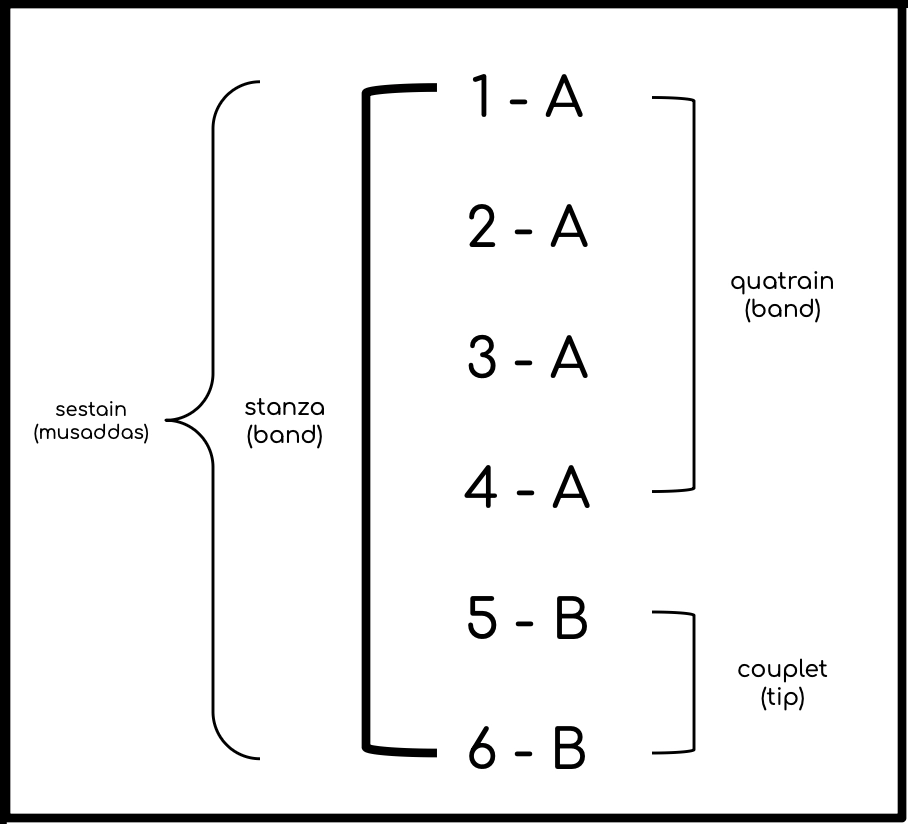
Musaddas is made up of six line stanzas. The first four lines (quatrain) are one rhyme (AA AA), and the last two (couplet) are a different rhyme (BB). The first four lines (band) having one rhyme and the final two lines (tip) have another. Here is a visual:
In comparison, there are other rhyme schemes as well, ex. ABAB or ABCB in ballads, AABBA in limericks, AABB which is paired rhyme, ABAB which is alternating rhyme, etc. With modern and post modern poetry, there is experimentation with free verse even in Marsiya, and in the related genre of Noha, which has less concern for the metrical component.
Schools
There are four major regional schools of Urdu Marsiya:
1.) Dakhni/Deccani
2.) Dehlavi
3.) Lucknavi/Awadhi
4.) Pakistani
Kashmiri Marsiya dates back to the 15th century, but its form and structure varies widely, and it is not in the Urdu language. Marsiya reached its zenith under the Nawabs of Awadh which were Shia of Persian origin, in power from the 18-mid 19th centuries in northern India.
Mir Anis (d. 1874) and Mirza Dabeer (d. 1875) were pivotal for Marsiya, and their lives, work, and impact will be studied in subsequent posts. To finish here, I wanted to share a couplet from Mir Anis' Marsiya. It refers to the caravan of believers with Husayn leading up to the momentous tragedy:
References
List of Marsiya Writers - Wikipedia
ShiaIndia.com - Marsiya
NohayOnline.com - Noha
eMarsiya.com - Asghar Mehdi Ashar's
RanaSafvi.com - Interesting posts
Rekhta.org - Marsiya
LampsofDesert.wordpress.com - Great posts
FranPritchett.com - Professor at Columbia
RememberingKarbala.com - Marsiya poets
UrduPoint.com - Lots of poets and poetry
Battle of Karbala - Wikipedia
Britannica.com - Karbala
