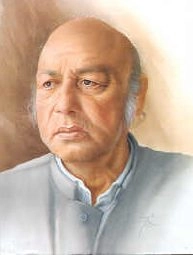
Among the most well known Urdu poets that spoke on topics of justice for the downtrodden, resistance to oppression and the overturning of the system that favors only the few was Habib Jalib (d. 1993), admired as a revolutionary poet from Pakistan.
He wrote primarily in Urdu and Punjabi, and was titled as the 'poet of the masses' for addressing the concerns of ordinary people and for composing poetry that was accessible in its vocabulary and content. He is highly admired by the people of Pakistan though his fame has not reached the same extent across the subcontinent. He was part of the Progressive Writers' Movement and wrote critically of various regimes that he lived through, and at times in praise of those that worked in the interest of humanity.
He has numerous works including Kulliyate Habib Jalib which collects his poetry in one place. His poem called Dastur is a marvel and I concentrate upon it here. I read five translations to English after reading the Urdu text and wrote a translation myself. After it, there is a breakdown and summary of its content for clarity.
The System (Dastur) by Habib Jalib
The lamp that burns only within palaces,
That which brings the joy of only a few,
That thrives in the shadow of expedience.
Such a system,
Like a dawn deprived of light,
I do not believe, I do not recognize.
I do not fear the hangman's gallows,
Tell the enemy, I am Mansur!
Why do you scare me with the prison’s walls?
This matter of tyranny,
This night of ignorance,
I do not believe, I do not recognize.
‘Flowers bloom on the branches,’ you say,
‘The thirsty have gotten their wine,’ you say,
‘Wounded hearts are stitched at last,’ you say.
This blatant lie,
This insult to the mind,
I do not believe, I do not recognize.
For centuries you have ravaged our calm,
But your sorcery works on us no longer.
Why do you pretend to be a healer for the grieving?
You are no healer.
Though others may accept so,
I do not believe, I do not recognize.
He speaks of the powers that be that have created a system that works to favor themselves and for their expedience and self interest, the select few and the elites to the exclusion of the masses of ordinary people. He compares the system (dastur) to a dawn that is deprived of light meaning that it makes no sense for there to be day without light, or for the time of brightness to be darkness. It is so absurd that we will not believe in it, nor will we acknowledge or recognize it to be valid.
He proceeds to proclaim his bravery and affinity to justice claiming himself immune to the means of control and subversion such as the hangman's gallows or the prison's walls meant to scare him into silence and obedience. Rather, he does not believe in this matter of tyranny and this night of ignorance. He compares himself to Mansur al Hallaj, a 10th century Sufi figure that was imprisoned, tortured and executed at last for having uttered 'I am the truth!' (Ana al Haqq). He was branded with heresy.
I interpret Mansur to be an archetype of the same spirit as Jalib from the past from many perspectives. Surrounded by those that submitted and feared voicing their opinion, Mansur was brave and aligned his body, mind and soul as one. He believed in his individual will, and did not allow others to determine that for him. Similarly, Jalib was imprisoned and tortured, and declared himself transcendent to the few in power ravaging the lives of innocent people around the world.
Then, quoting those oppressive powers that constantly tell the people that things are okay and that things are getting better, Jalib calls all of this to be a blatant lie and an insult to the mind. They could claim that the stock market is doing great or that the economy and GDP is growing, with no care for the standard of living which matters more. He gave three statements: they claim that the flowers are blooming on branches, so spring is coming and everything is going well, that the thirsty have been satiated with their wine, which could be a metaphor as used often in poetry, and that the wounded hearts of people are getting stitched up to heal. Misrepresentations, lies and propaganda.
At last, he summarizes what the few have done for centuries by burdening the people with restriction and exploitation despite having been created free, a kind of bondage that persisted because we were under their sorcery. But we broke the spell and now, we see things clearly as they are. We can distinguish the oppressors from the oppressed, and we will not be manipulated to think otherwise.
References
Habib Jalib - Biography
Habib Jalib - Works
Habib Jalib - Ideas
Habib Jalib - Revolutionary Thought
Habib Jalib - Poetry
Dastur - Translation
Dastur - Urdu Text
Dastur - Translation
Dastur - Translation
Dastur - Translation
Dastur - Translation
