Bawa Muhaiyaddeen was a revered religious and spiritual figure from Sri Lanka who spent the last fifteen years of his life in Philadelphia. He was a saint affiliated with the Qadiri Order of Sufism, widely respected for the universality of his message.
He was a shy man who preferred to keep the details of his life hidden and obscure, and often redirected the focus back to God. The exact year of his birth is unknown, and much of his life in Sri Lanka remains a mystery. He was discovered by the world only after he was invited to the United States.
His name was Muhammad Raheem, though he was referred to by his disciples with titles including Bawa, Guru, Swami, Sheikh, Qutb, and His Holiness.
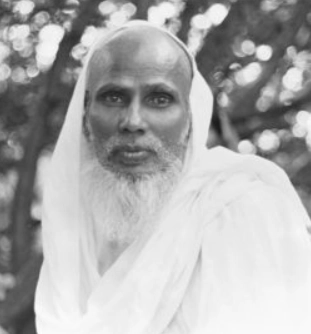
Bawa engaged in deep spiritual retreat for twelve years at Daftar Jailani, a revered cliffside shrine dedicated to Abdul Qadir Jilani, the founder of the Qadiri Order. During this period, he immersed himself in prayer, meditation and inner reasoning. What would come from the heart and mind of such a man except a divine passion? He emerged in the early 1940s and began to share his experiences, knowledge and healing abilities.
In his recounting, the jungle is a marvelous place:
Fatima Carolyn Andrews, a spiritual seeker in the United States, invited Bawa after corresponding through a Sri Lankan student at the University of Pennsylvania. Bawa accepted and journeyed to Philadelphia in 1971 and found an ever growing and receptive community that continues to this day.
Bawa primarily spoke Tamil, one of the world’s oldest languages with a rich literary tradition. Tamil is the official language of Tamil Nadu and Pondicherry in India, and one of the official languages of Sri Lanka and Singapore. Eelam Tamil, the variant spoken in Sri Lanka, is more conservative than its Indian counterparts because it preserves more features from Old and Middle Tamil.
Bawa also used Arwi, a dialect of Tamil heavily influenced by Arabic and written in the Arabic script. This hybrid language emerged through centuries of interaction between Arab traders and the Tamil people of Serendib (ancient Sri Lanka).
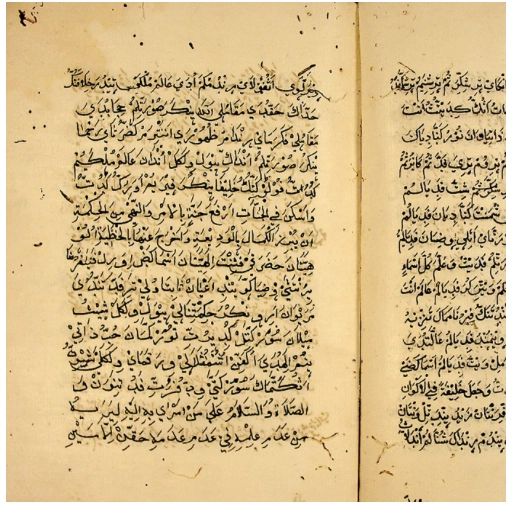
Although he was illiterate, it was from the several thousand hours of lectures that over 25 books were transcribed and compiled. Some of the most widely known include Golden Words of a Sufi Shaykh which is a collection of his short teachings, The Tree That Fell to the West which is his autobiography and Four Steps to Pure Iman about the path to reaching God.
Bawa also created artwork and drawings on spiritual, religious, and social themes, many of which are featured in his books. He had followers that were Muslim, Hindu, Buddhist, Christian and Jewish, between Sri Lanka and the United States.
Bawa was a vegetarian and taught its importance as a guiding principle of the fellowship. The Tasty Economical Cookbook is a book full of vegetarian recipes.
He called for a higher sense of unity not based on the divisions such as color, race, religion and language, though he was himself a devout Muslim.
He embodies someone that internalized the message of Islam. His writings, artwork and songs remind me of a passage from the Quran:
Among Bawa’s close disciples was Dr. Gwendolyn Zoharah Simmons, a civil rights activist and academic who became Bawa’s student in 1971. He gave her the name Zoharah, and she was deeply cherished in his circle. Her academic work has focused on religion, gender equality and social ethics, including her dissertation which was The Contemporary Impact of Shari'ah Law on Women's Lives in Jordan and Palestine.
Another prominent student was Musa Muhaiyaddeen (formerly E.L. Levin), who became his student in 1972. Musa is the host of the podcast The Witness Within and the author of works such as The Elixir of Truth: Inner Dimensions and Sufi Illuminations.
In 1973, the Bawa Muhaiyaddeen Fellowship (BMF) was formally established in Philadelphia and has continued to be a center to gather and learn. No formal successor was appointed, and the community has since continued based on the living legacy of his teachings.
The Fellowship and Mosque are located in Philadelphia, while the Mazar (Bawa’s shrine) and Fellowship Farm are in Coatesville, Pennsylvania, about an hour’s drive away. His teachings have spread globally with branches in Sri Lanka, Canada, Australia, the UK, and across the United States.
Bawa passed away in 1986, but his message continues to resonate around the world. The land he came from, Sri Lanka, was a crossroads of civilizations, and Bawa’s teachings reflect that spirit which transcended the limitations of language, background, and culture.
References
Bawa Muhaiyaddeen - Wikipedia Page
Bawa Muhaiyaddeen Foundation - Background information
American Sufi Shrine of Bawa Muhaiyaddeen -
BMF, Canada - None
Charisma and Community: A Brief History of the Bawa Muhaiyaddeen Fellowship -
Works Cited
Muhaiyaddeen, M. R. Bawa. The Golden Words of a Sufi Sheikh. Fellowship Press, 2006.
Muhaiyaddeen, M. R. Bawa. The Tree that Fell to the West: Autobiography of a Sufi. Fellowship Press, 2003.
Pickthall, Mohammed Marmaduke, translator. The Meaning of the Glorious Koran. New American Library, 1953.
